119942
论文已发表
注册即可获取德孚的最新动态
IF 收录期刊
- 3.6 Breast Cancer (Dove Med Press)
- 4.3 Clin Epidemiol
- 2.6 Cancer Manag Res
- 3.2 Infect Drug Resist
- 4.1 Clin Interv Aging
- 6.1 Drug Des Dev Ther
- 4.1 Int J Chronic Obstr
- 8.7 Int J Nanomed
- 2.5 Int J Women's Health
- 3.2 Neuropsych Dis Treat
- 2.4 OncoTargets Ther
- 2.6 Patient Prefer Adher
- 2.6 Ther Clin Risk Manag
- 3.1 J Pain Res
- 3.5 Diabet Metab Synd Ob
- 4.5 Psychol Res Behav Ma
- 3.4 Nat Sci Sleep
- 2.4 Pharmgenomics Pers Med
- 2.6 Risk Manag Healthc Policy
- 4.6 J Inflamm Res
- 2.3 Int J Gen Med
- 3.9 J Hepatocell Carcinoma
- 3.3 J Asthma Allergy
- 2.5 Clin Cosmet Investig Dermatol
- 3.0 J Multidiscip Healthc

急性缺血性卒中患者维生素 D 水平与认知障碍的关系:一项前瞻性队列研究
Authors Chen H, Liu Y, Huang G, Zhu J, Feng W, He J
Received 11 September 2018
Accepted for publication 18 November 2018
Published 10 December 2018 Volume 2018:13 Pages 2503—2509
DOI https://doi.org/10.2147/CIA.S187142
Checked for plagiarism Yes
Review by Single-blind
Peer reviewers approved by Dr Andrew Yee
Peer reviewer comments 3
Editor who approved publication: Dr Zhi-Ying Wu
Objective: Previous
studies found that low vitamin D levels were modestly associated with risk of stroke
and poor functional outcome after stroke. In addition, vitamin D deficiency has
been linked with cognitive decline. Our study aimed to explore the potential
relationship between vitamin D levels in the short-term acute phase of ischemic
stroke and cognitive impairment at 1 month.
Methods: In total,
354 ischemic stroke patients were consecutively enrolled in the study and
received 1-month follow-up. The serum levels of vitamin D were measured within
24 hours after admission. Cognitive function was evaluated by the
Mini-Mental State Examination (MMSE) at 1 month after acute ischemic
stroke. Cognitive impairment was defined according to different education
levels.
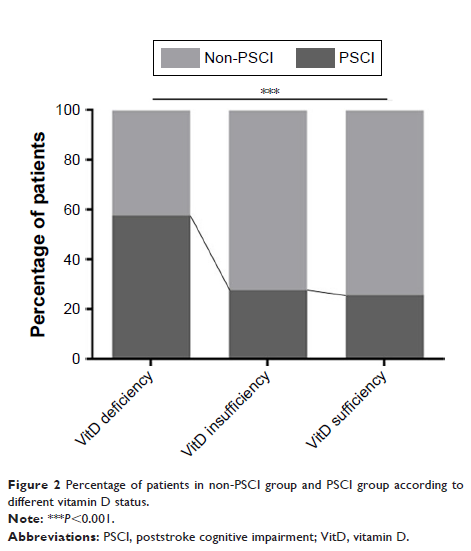
Results: According
to MMSE scores, 114 participants (32.2%) had cognitive impairment at 1 month.
Patients with vitamin D deficiency were more likely to have cognitive
impairment than those with vitamin D insufficiency and vitamin D sufficiency (P <0.001). After
adjusting for potential confounders in our Cox proportional hazards model,
vitamin D deficiency was independently associated with the development of
cognitive impairment in acute ischemic stroke patients.
Conclusion: Independent
of established risk factors, vitamin D deficiency in the short-term phase of
ischemic stroke was associated with a higher incidence of 1-month cognitive
impairment.
Keywords: vitamin
D, cognitive impairment, ischemic stroke, Mini-Mental State Examination