119942
论文已发表
注册即可获取德孚的最新动态
IF 收录期刊
- 3.6 Breast Cancer (Dove Med Press)
- 4.3 Clin Epidemiol
- 2.6 Cancer Manag Res
- 3.2 Infect Drug Resist
- 4.1 Clin Interv Aging
- 6.1 Drug Des Dev Ther
- 4.1 Int J Chronic Obstr
- 8.7 Int J Nanomed
- 2.5 Int J Women's Health
- 3.2 Neuropsych Dis Treat
- 2.4 OncoTargets Ther
- 2.6 Patient Prefer Adher
- 2.6 Ther Clin Risk Manag
- 3.1 J Pain Res
- 3.5 Diabet Metab Synd Ob
- 4.5 Psychol Res Behav Ma
- 3.4 Nat Sci Sleep
- 2.4 Pharmgenomics Pers Med
- 2.6 Risk Manag Healthc Policy
- 4.6 J Inflamm Res
- 2.3 Int J Gen Med
- 3.9 J Hepatocell Carcinoma
- 3.3 J Asthma Allergy
- 2.5 Clin Cosmet Investig Dermatol
- 3.0 J Multidiscip Healthc

NLRP6 在胃癌中降低可抑制胃癌细胞的致肿瘤性
Authors Wang Q, Wang C, Chen J
Received 7 August 2018
Accepted for publication 11 October 2018
Published 27 November 2018 Volume 2018:10 Pages 6431—6444
DOI https://doi.org/10.2147/CMAR.S182980
Checked for plagiarism Yes
Review by Single-blind
Peer reviewers approved by Dr Justinn Cochran
Peer reviewer comments 2
Editor who approved publication: Dr Chien-Feng Li
Background: Helicobacter pylori (H. pylori ) infection
has been regarded as a main risk factor for gastric cancer. Nod-like receptor
pyrin domain-containing protein 6 (NLRP6), a component of inflammasome, has
been linked to colorectal tumorigenesis. Here, we aimed to evaluate NLRP6
expression profile and functions in gastric cancer.
Materials and methods: We examined
NLRP6 expression in gastric cancer and adjacent normal gastric tissues. The
biological functions and mechanism of NLRP6 overexpression in gastric cancer
cells were investigated.
Results: Downregulated
NLRP6 expression in human gastric cancer significantly correlated with H. pylori infection,
tumor size, TNM stage, lymph node metastasis, and overall survival. NLRP6
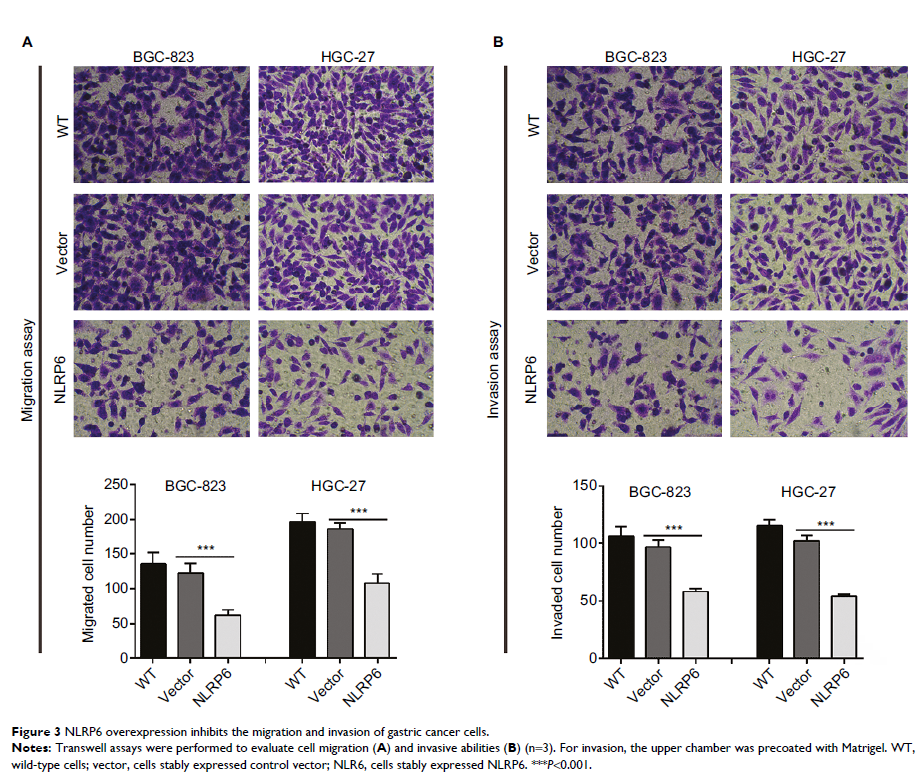
overexpression in gastric cancer cells led to a significant decrease in cell
proliferation, migration, and invasion, as well as a notable increase in cell
apoptosis, whereas NLRP6 knockdown had opposing effects. In addition, NLRP6
overexpression significantly repressed STAT3 phosphorylation and the
transcription of its target genes, Bcl-2 and MMP-2. Moreover, forkhead box O3
(FOXO3), a transcription factor regulated by H. pylori , was
demonstrated as an upstream regulator of NLRP6 transcription.
Conclusion: Our study
may provide insight into the understanding of NLRP6 as a tumor suppressor and
implicate the potential application of NLRP6 for gastric cancer treatment.
Keywords: NLRP6, H. pylori , cell
proliferation, cell apoptosis, gastric cancer