119661
论文已发表
注册即可获取德孚的最新动态
IF 收录期刊
- 3.6 Breast Cancer (Dove Med Press)
- 4.3 Clin Epidemiol
- 2.6 Cancer Manag Res
- 3.2 Infect Drug Resist
- 4.1 Clin Interv Aging
- 6.1 Drug Des Dev Ther
- 4.1 Int J Chronic Obstr
- 8.7 Int J Nanomed
- 2.5 Int J Women's Health
- 3.2 Neuropsych Dis Treat
- 2.4 OncoTargets Ther
- 2.6 Patient Prefer Adher
- 2.6 Ther Clin Risk Manag
- 3.1 J Pain Res
- 3.5 Diabet Metab Synd Ob
- 4.5 Psychol Res Behav Ma
- 3.4 Nat Sci Sleep
- 2.4 Pharmgenomics Pers Med
- 2.6 Risk Manag Healthc Policy
- 4.6 J Inflamm Res
- 2.3 Int J Gen Med
- 3.9 J Hepatocell Carcinoma
- 3.3 J Asthma Allergy
- 2.5 Clin Cosmet Investig Dermatol
- 3.0 J Multidiscip Healthc

Notch 信号通过 EPHB2 和 EPHB4 的表观遗传修饰促进结直肠癌中的锯齿状瘤形成途径
Authors Lian H, Jia X, Shi N, Xie S, Wang J, Wang W, Ma F, Liu H, Wang A, Cheng X, Liu C
Received 24 June 2018
Accepted for publication 7 October 2018
Published 22 November 2018 Volume 2018:10 Pages 6129—6141
DOI https://doi.org/10.2147/CMAR.S178126
Checked for plagiarism Yes
Review by Single-blind
Peer reviewers approved by Dr Cristina Weinberg
Peer reviewer comments 2
Editor who approved publication: Professor Nakshatri
Background: Dysregulation
of erythropoietin-producing hepatoma (Eph) proteins in human cancers is
extensively documented but not clear in colorectal cancer (CRC). In this study,
we aimed to investigate the role of Notch signaling pathway and epigenetic
modification of EPHB2 and EPHB4 expression in serrated neoplasia
development.
Methods: The
expression of EPHB2 and EPHB4 in CRC clinical specimens and cell lines were
determined by immunohistochemistry, Western blot, and real-time PCR. Cell
proliferation and invasion were evaluated by MTT and chamber kits, luciferase
assay and co-immunoprecipitation were used to detect the transcriptional
regulation and protein–protein interactions, respectively. The
immunofluorescence assay was employed to confirm the subcellular location of
Notch intracellular domain (NICD), and chromatin immunoprecipitation assay was
implied to detect the modification types of H3K4me3 and H3K27me3. Mice
xenograft model was used to detect the in vivo effects of EPHB2 and EPHB4 genes
on cell growth.
Results: In
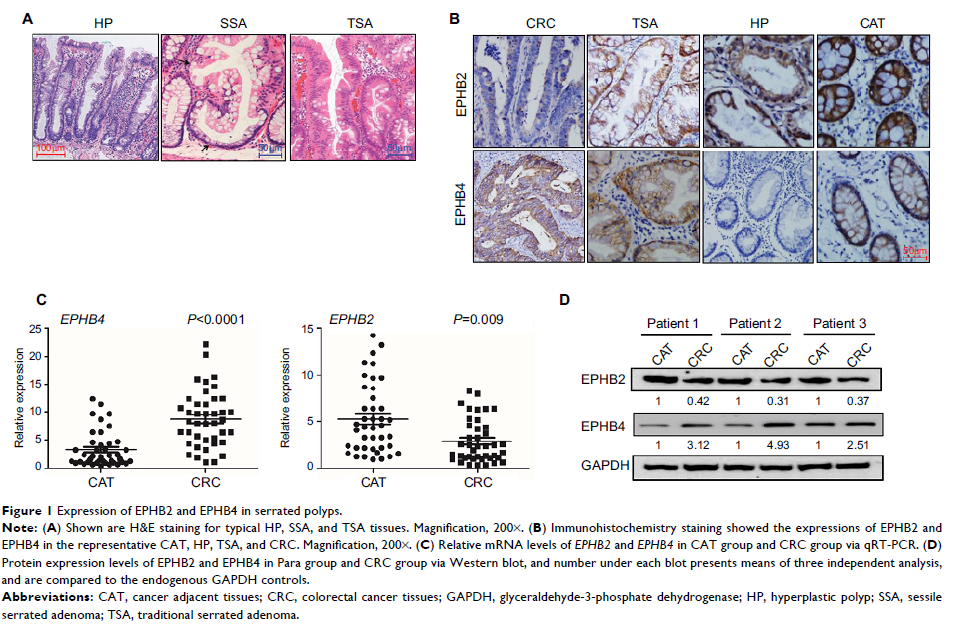
CRC clinical specimens and cell lines, we found that EPHB2 was significantly
decreased, while EPHB4 was elevated in the CRC tissues, and these aberrant
expression manners correlated with worse overall survival rates in the clinic.
When the EPHB2 and EPHB4 expressions were manipulated by overexpression or
knockdown in the SW620 cells, the cell proliferation and invasion were
obviously suppressed, whereas EPHB2 knockdown or EPHB4 overexpression showed
the opposite phenotypes. We also found that Notch signaling pathway was
abnormally activated and treatment of Notch signaling ligand human Jagged1
peptide downregulated EPHB2 and upregulated EPHB4 in the SW620 cells, as well
as promoted the chromatin modification protein Jumonji domain-containing
protein-3 (JMJD3) cytonuclear trans-localization with the NICD, which indicated
that NICD brought JMJD3 to the EPHB4 enhancer region to decrease the H3K27me3
level.
Conclusion: Taken
together, we provide a new mechanistic option in understanding the role of
Notch signaling and the roles of EPHB2 and EPHB4 in CRC.
Keywords: Notch
signaling, Eph gene, histone methylation, colorectal cancer