119661
论文已发表
注册即可获取德孚的最新动态
IF 收录期刊
- 3.6 Breast Cancer (Dove Med Press)
- 4.3 Clin Epidemiol
- 2.6 Cancer Manag Res
- 3.2 Infect Drug Resist
- 4.1 Clin Interv Aging
- 6.1 Drug Des Dev Ther
- 4.1 Int J Chronic Obstr
- 8.7 Int J Nanomed
- 2.5 Int J Women's Health
- 3.2 Neuropsych Dis Treat
- 2.4 OncoTargets Ther
- 2.6 Patient Prefer Adher
- 2.6 Ther Clin Risk Manag
- 3.1 J Pain Res
- 3.5 Diabet Metab Synd Ob
- 4.5 Psychol Res Behav Ma
- 3.4 Nat Sci Sleep
- 2.4 Pharmgenomics Pers Med
- 2.6 Risk Manag Healthc Policy
- 4.6 J Inflamm Res
- 2.3 Int J Gen Med
- 3.9 J Hepatocell Carcinoma
- 3.3 J Asthma Allergy
- 2.5 Clin Cosmet Investig Dermatol
- 3.0 J Multidiscip Healthc

构建一个可预测远端转移性非小细胞肺癌患者总体生存的诺模图
Authors Deng JQ, Ren ZP, Wen JX, Wang B, Hou XB, Xue ZQ, Chu XY
Received 14 August 2018
Accepted for publication 9 October 2018
Published 22 November 2018 Volume 2018:10 Pages 6143—6156
DOI https://doi.org/10.2147/CMAR.S183878
Checked for plagiarism Yes
Review by Single-blind
Peer reviewers approved by Dr Andrew Yee
Peer reviewer comments 3
Editor who approved publication: Dr Chien-Feng Li
Purpose: This study
aimed to establish a nomogram to predict the overall survival (OS) of the
general non-small-cell lung cancer (NSCLC) patients with distant metastasis.
Patients and methods: We investigated
Surveillance, Epidemiology, and End Results database for NSCLC patients with
distant metastasis diagnosed between 2010 and 2014. Statistically significant
prognostic factors were identified using uni- and multivariable Cox regression
analyses. A nomogram incorporating these prognostic factors was developed and
evaluated by the Harrell’s concordance index (C-index), calibration plots, and
risk group stratifications.
Results: We
finally included 18,209 patients for analysis. These patients were divided into
two groups, 14,567 cases for the training cohort and 3,642 for the validation
cohort. Marital status, sex, race, age, histology, T stage, N stage,
histological differentiation, bone metastasis, brain metastasis, liver
metastasis, with M1a disease, surgery of primary cancer, and chemotherapy were
identified as the prognostic factors of the OS and integrated to construct the
nomogram. The nomogram had a C-index of 0.704 (95% CI: 0.699–0.709) in the
training set and 0.699 (95% CI: 0.689–0.709) in the validation set. The
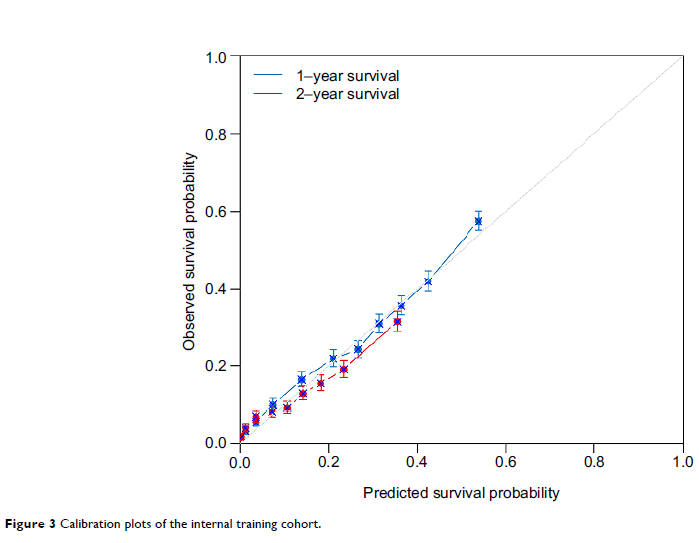
calibration curves for 1- and 2-year OS in the training and validation sets showed
acceptable agreement between the predicted and observed survival. Also, the
nomogram was capable of stratifying patients into different risk groups within
the patients who presented with bone, liver, or brain metastasis, as well as in
each T, N stage, respectively.
Conclusion: A
nomogram was established and validated to predict individual prognosis for the
general patients with distantly metastatic NSCLC. Global prospective data with
the latest TNM classification and more comprehensive prognostic factors are
needed to improve this model.
Keywords: nomogram,
metastatic lung cancer, SEER, prognosis, overall survival, prediction