119661
论文已发表
注册即可获取德孚的最新动态
IF 收录期刊
- 3.6 Breast Cancer (Dove Med Press)
- 4.3 Clin Epidemiol
- 2.6 Cancer Manag Res
- 3.2 Infect Drug Resist
- 4.1 Clin Interv Aging
- 6.1 Drug Des Dev Ther
- 4.1 Int J Chronic Obstr
- 8.7 Int J Nanomed
- 2.5 Int J Women's Health
- 3.2 Neuropsych Dis Treat
- 2.4 OncoTargets Ther
- 2.6 Patient Prefer Adher
- 2.6 Ther Clin Risk Manag
- 3.1 J Pain Res
- 3.5 Diabet Metab Synd Ob
- 4.5 Psychol Res Behav Ma
- 3.4 Nat Sci Sleep
- 2.4 Pharmgenomics Pers Med
- 2.6 Risk Manag Healthc Policy
- 4.6 J Inflamm Res
- 2.3 Int J Gen Med
- 3.9 J Hepatocell Carcinoma
- 3.3 J Asthma Allergy
- 2.5 Clin Cosmet Investig Dermatol
- 3.0 J Multidiscip Healthc

诺模图用于预测骨肉瘤总体特征和癌症特异性存活率
Authors Zheng W, Huang Y, Chen H, Wang N, Xiao W, Liang Y, Jiang X, Su W, Wen S
Received 22 June 2018
Accepted for publication 7 September 2018
Published 8 November 2018 Volume 2018:10 Pages 5439—5450
DOI https://doi.org/10.2147/CMAR.S177945
Checked for plagiarism Yes
Review by Single-blind
Peer reviewers approved by Dr Justinn Cochran
Peer reviewer comments 2
Editor who approved publication: Dr Antonella D'Anneo
Purpose: A prognostic nomogram was applied to predict survival in osteosarcoma
patients.
Patients and
methods: Data collected from 2,195
osteosarcoma patients in the Surveillance, Epidemiology, and End Results (SEER)
database between 1983 and 2014 were analyzed. Independent prognostic factors
were identified via univariate and multivariate Cox analyses. These were
incorporated into a nomogram to predict 3- and 5-year overall survival (OS) and
cancer-specific survival (CSS) rates. Internal and external data were used for
validation. Concordance indices (C-indices) were used to estimate nomogram
accuracy.
Results: Patients were randomly assigned into a training cohort (n=1,098) or
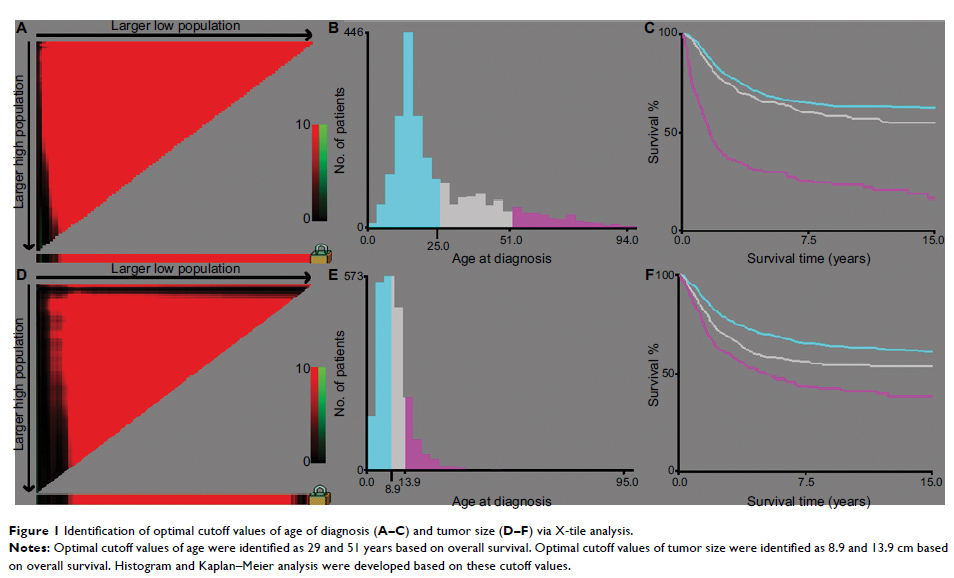
validation cohort (n=1,097). Age at diagnosis, tumor site, histology, tumor
size, tumor stage, use of surgery, and tumor grade were identified as
independent prognostic factors via univariate and multivariate Cox analyses
(all P <0.05) and then included in
the prognostic nomogram. C-indices for OS and CSS prediction in the training
cohort were 0.763 (95% CI 0.761–0.764) and 0.764 (95% CI 0.762–0.765),
respectively. C-indices for OS and CSS prediction in the external validation
cohort were 0.739 (95% CI 0.737–0.740) and 0.740 (95% CI, 0.738–0.741),
respectively. Calibration plots revealed excellent consistency between actual
survival and nomogram prediction.
Conclusion: Nomograms were constructed to predict OS and CSS for osteosarcoma
patients in the SEER database. They provide accurate and individualized
survival prediction.
Keywords: cancer-specific survival, nomogram, osteosarcoma, overall
survival, prognosis, SEER database