119661
论文已发表
注册即可获取德孚的最新动态
IF 收录期刊
- 3.6 Breast Cancer (Dove Med Press)
- 4.3 Clin Epidemiol
- 2.6 Cancer Manag Res
- 3.2 Infect Drug Resist
- 4.1 Clin Interv Aging
- 6.1 Drug Des Dev Ther
- 4.1 Int J Chronic Obstr
- 8.7 Int J Nanomed
- 2.5 Int J Women's Health
- 3.2 Neuropsych Dis Treat
- 2.4 OncoTargets Ther
- 2.6 Patient Prefer Adher
- 2.6 Ther Clin Risk Manag
- 3.1 J Pain Res
- 3.5 Diabet Metab Synd Ob
- 4.5 Psychol Res Behav Ma
- 3.4 Nat Sci Sleep
- 2.4 Pharmgenomics Pers Med
- 2.6 Risk Manag Healthc Policy
- 4.6 J Inflamm Res
- 2.3 Int J Gen Med
- 3.9 J Hepatocell Carcinoma
- 3.3 J Asthma Allergy
- 2.5 Clin Cosmet Investig Dermatol
- 3.0 J Multidiscip Healthc

对食道癌老年人进行的同步放化疗:最先进的和有未来前景的治疗
Authors Song T, Fang M, Wu S
Received 3 July 2018
Accepted for publication 28 September 2018
Published 8 November 2018 Volume 2018:13 Pages 2275—2287
DOI https://doi.org/10.2147/CIA.S179014
Checked for plagiarism Yes
Review by Single-blind
Peer reviewers approved by Dr Colin Mak
Peer reviewer comments 3
Editor who approved publication: Dr Wu
Purpose: The aim of this study was to review the published literature addressing
the question of whether geriatric assessment (GA) should be routinely applied
in the treatment of older adults with esophageal cancer (EC) who have received
definitive concurrent chemoradiotherapy (dCRT).
Materials and
methods: A literature search of PubMed,
Embase, and Cochrane Library was performed. Studies that contained original
data outlining the inclusion and exclusion criteria, treatment compliance rate,
and severe toxicity reports were reviewed. Additionally, criteria from ongoing
clinical trials in the World Health Organization and National Institutes of
Health registries were reviewed to evaluate the utilization of GA-related
domains in elderly EC patients who received dCRT.
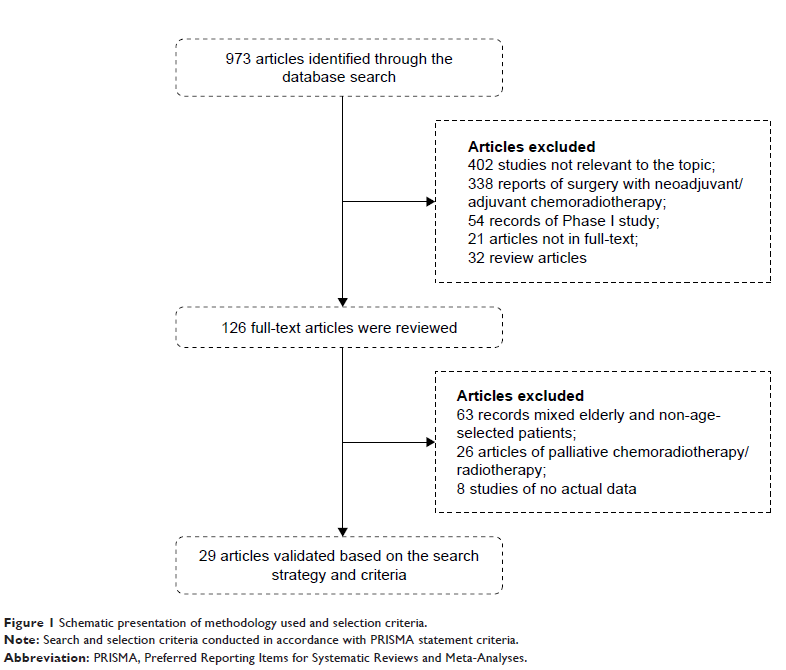
Results: Twenty-nine studies were identified based on the selection criteria:
five were single-arm prospective studies, and the other studies were
retrospective studies. All studies used chronological age and performance
status as basic descriptors for this subpopulation. The comorbidity index and
the malnutrition level were mentioned in several studies. However, factors such
as “Demographic data and social support,” “Psychology,” “Polypharmacy,” and
“Geriatric syndromes” were not described in any of the included studies.
Unfortunately, the results were similar for the registered clinical trials.
Finally, treatment compliance and toxicity profile were found to be acceptable
in selected elderly EC patients.
Conclusion: The current experience for older adults with EC receiving dCRT is mainly
based on the results of a series of retrospective studies. Ongoing clinical
trials should routinely consider GA-related domains to select appropriate
treatments for patients in the future.
Keywords: older adults, esophageal cancer, chemoradiotherapy, inclusion
criteria, toxicity, geriatric assessment