119661
论文已发表
注册即可获取德孚的最新动态
IF 收录期刊
- 3.6 Breast Cancer (Dove Med Press)
- 4.3 Clin Epidemiol
- 2.6 Cancer Manag Res
- 3.2 Infect Drug Resist
- 4.1 Clin Interv Aging
- 6.1 Drug Des Dev Ther
- 4.1 Int J Chronic Obstr
- 8.7 Int J Nanomed
- 2.5 Int J Women's Health
- 3.2 Neuropsych Dis Treat
- 2.4 OncoTargets Ther
- 2.6 Patient Prefer Adher
- 2.6 Ther Clin Risk Manag
- 3.1 J Pain Res
- 3.5 Diabet Metab Synd Ob
- 4.5 Psychol Res Behav Ma
- 3.4 Nat Sci Sleep
- 2.4 Pharmgenomics Pers Med
- 2.6 Risk Manag Healthc Policy
- 4.6 J Inflamm Res
- 2.3 Int J Gen Med
- 3.9 J Hepatocell Carcinoma
- 3.3 J Asthma Allergy
- 2.5 Clin Cosmet Investig Dermatol
- 3.0 J Multidiscip Healthc

Peroxiredoxin1 的表达下调可抑制卵巢癌细胞的增殖、侵袭和转移
Authors Zheng MJ, Wang J, Wang HM, Gao LL, Li X, Zhang WC, Gou R, Guo Q, Nie X, Liu J, Lin B
Received 23 May 2018
Accepted for publication 10 September 2018
Published 2 November 2018 Volume 2018:11 Pages 7745—7761
DOI https://doi.org/10.2147/OTT.S175009
Checked for plagiarism Yes
Review by Single-blind
Peer reviewers approved by Dr Colin Mak
Peer reviewer comments 4
Editor who approved publication: Dr William Cho
Aim: The aim of this study was to explore the expression of
peroxiredoxin1 (PRDX1) in epithelial ovarian cancer, analyze the relationship
between PRDX1 and clinicopathologic parameters of patients with ovarian cancer,
including their prognosis, and describe changes and the mechanisms involved in
malignant biologic behavior of ovarian cancer cells when PRDX1 expression is
inhibited.
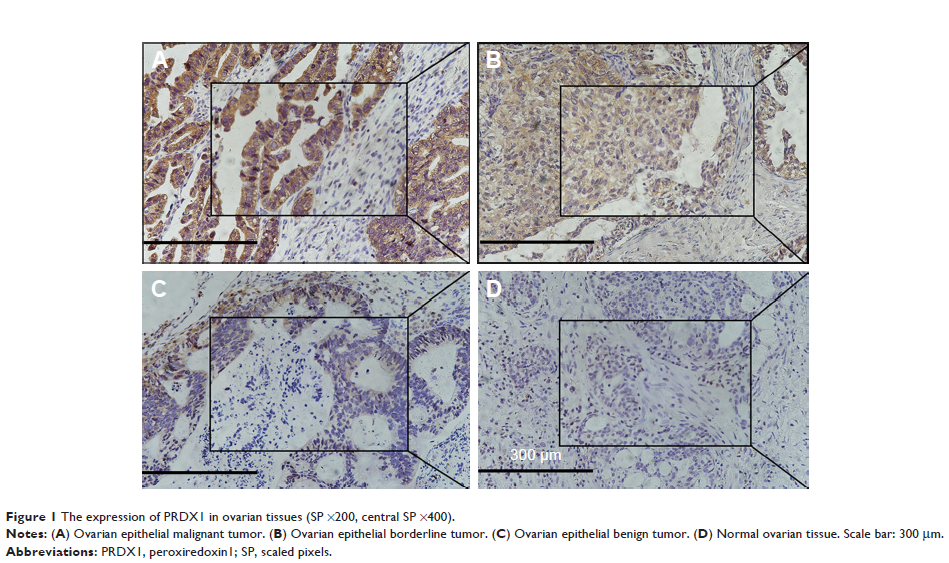
Methods: The expression of PRDX1 was detected immunohistochemically in 15
samples of normal ovarian tissue, 21 benign, 11 borderline, and 101 malignant
epithelial ovarian tumors. Changes in ovarian cancer cell proliferation,
invasion, and metastasis before and after inhibiting PRDX1 expression were
assessed by cell function assay. Additionally, gene set enrichment analysis
(GSEA) of PRDX1 was performed by the Cancer Genome Atlas database. A
protein–protein interaction network was then constructed and a pathway function
analysis of the genes in the network was conducted.
Results: PRDX1 expression was mainly localized to the cytoplasm, as well as the
nucleus of cells. The expression rate of PRDX1 in epithelial ovarian malignant
tissues (96.04%) was significantly higher than that in borderline (72.72%) and
benign (57.14%) epithelial ovarian tumors, and normal ovarian tissue (20%;
all P <0.05). Cox multivariate
regression analysis indicated that advanced clinical stage, low tissue
differentiation, and high expression of PRDX1 were independent risk factors
affecting the prognosis of epithelial ovarian cancer (all P <0.05). Cell function assay
verified that the decreased expression of PRDX1 inhibited ovarian cancer cell
proliferation, invasion, and metastasis. GSEA analysis indicated that PRDX1 was
significantly related to the Wnt signaling pathway. Western blot analysis
confirmed that PRDX1 could regulate the expression of β-catenin in the Wnt
pathway.
Conclusion: Decreased expression of PRDX1 can attenuate cell proliferation,
invasion, and metastasis of ovarian cancer cells. The expression of PRDX1 is
related to the prognosis of patients with ovarian cancer and can therefore be
used as a biomarker.
Keywords: epithelial ovarian cancer, peroxiredoxin1, immunohistochemistry,
invasion, metastasis, pathways