119661
论文已发表
注册即可获取德孚的最新动态
IF 收录期刊
- 3.6 Breast Cancer (Dove Med Press)
- 4.3 Clin Epidemiol
- 2.6 Cancer Manag Res
- 3.2 Infect Drug Resist
- 4.1 Clin Interv Aging
- 6.1 Drug Des Dev Ther
- 4.1 Int J Chronic Obstr
- 8.7 Int J Nanomed
- 2.5 Int J Women's Health
- 3.2 Neuropsych Dis Treat
- 2.4 OncoTargets Ther
- 2.6 Patient Prefer Adher
- 2.6 Ther Clin Risk Manag
- 3.1 J Pain Res
- 3.5 Diabet Metab Synd Ob
- 4.5 Psychol Res Behav Ma
- 3.4 Nat Sci Sleep
- 2.4 Pharmgenomics Pers Med
- 2.6 Risk Manag Healthc Policy
- 4.6 J Inflamm Res
- 2.3 Int J Gen Med
- 3.9 J Hepatocell Carcinoma
- 3.3 J Asthma Allergy
- 2.5 Clin Cosmet Investig Dermatol
- 3.0 J Multidiscip Healthc

SIRT1 激活剂白藜芦醇通过抑制 Akt/mTOR 和激活 p38-MAPK 诱导非小细胞肺癌的自噬保护作用
Authors Wang J, Li J, Cao N, Li Z, Han J, Li L
Received 6 December 2017
Accepted for publication 30 May 2018
Published 2 November 2018 Volume 2018:11 Pages 7777—7786
DOI https://doi.org/10.2147/OTT.S159095
Checked for plagiarism Yes
Review by Single-blind
Peer reviewers approved by Dr Lucy Goodman
Peer reviewer comments 2
Editor who approved publication: Dr Jianmin Xu
Background: Resveratrol, a natural polyphenolic phytoalexin, has potent anti-tumor
activity. Recently, it was found to induce autophagy in cancer cells. However,
the effects of resveratrol on autophagy in non-small-cell lung cancer (NSCLC)
cells have not yet been clearly elucidated.
Materials and methods: A549 and H1299 cells were treated with different
concentrations of resveratrol. Cell growth and apoptosis were measured by CCK-8
assay and flow cytometry, respectively. A549 cells were then treated with 200
µM resveratrol or SRT1720. Cell autophagy was detected by western blot and
immunofluorescence.
Results: In this study, we found that resveratrol exerted the
anti-tumor effect through inhibiting cell proliferation and promoting cell
apoptosis in NSCLC cells dose-dependently. Resveratrol has also increased the
relative expression of Beclin1 and LC3 II/I while decreased p62 expression,
suggesting that resveratrol induced autophagy in NSCLC cells. In addition,
resveratrol increased SIRT1 expression and SIRT1 activator SRT1720-induced
autophagy of NSCLC cells. SIRT1 knockdown reduced resveratrol-induced autophagy
significantly. These results indicated that resveratrol might induce autophagy
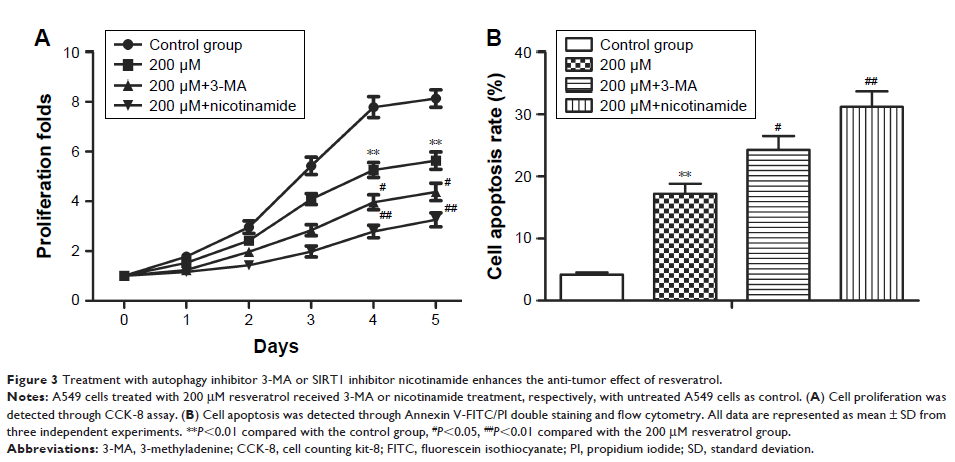
through upregulating SIRT1 expression. Moreover, inhibiting autophagy by
autophagy inhibitor 3-methyladenine or SIRT1 inhibitor nicotinamide
significantly suppressed proliferation while promoted apoptosis compared with
the resveratrol 200 µM group, suggesting that resveratrol-induced autophagy
might act as a protective mechanism to promote NSCLC cell survival and
inhibiting autophagy can enhance the anti-tumor effect of resveratrol. Besides
that, resveratrol treatment inhibited Akt/mTOR while p38-MAPK was activated in
NSCLC cells in a dose-dependent manner. Activating Akt/mTOR pathway by IGF-1 or
inhibiting p-38-MAPK pathway by doramapimod significantly inhibited cell
proliferation while increased cell apoptosis of NSCLC cells compared with the
resveratrol 200 µM group.
Conclusion: Taken together, our findings suggest that
resveratrol inhibited proliferation but induced apoptosis and autophagy via
inhibiting Akt/mTOR and activating p38-MAPK pathway. Resveratrol-induced
autophagy might act as a protective mechanism to promote NSCLC cell survival.
Therefore, inhibition of autophagy may enhance the anti-tumor activity of
resveratrol in NSCLC.
Keywords: resveratrol,
SIRT1, autophagy, non-small-cell lung cancer