119661
论文已发表
注册即可获取德孚的最新动态
IF 收录期刊
- 3.6 Breast Cancer (Dove Med Press)
- 4.3 Clin Epidemiol
- 2.6 Cancer Manag Res
- 3.2 Infect Drug Resist
- 4.1 Clin Interv Aging
- 6.1 Drug Des Dev Ther
- 4.1 Int J Chronic Obstr
- 8.7 Int J Nanomed
- 2.5 Int J Women's Health
- 3.2 Neuropsych Dis Treat
- 2.4 OncoTargets Ther
- 2.6 Patient Prefer Adher
- 2.6 Ther Clin Risk Manag
- 3.1 J Pain Res
- 3.5 Diabet Metab Synd Ob
- 4.5 Psychol Res Behav Ma
- 3.4 Nat Sci Sleep
- 2.4 Pharmgenomics Pers Med
- 2.6 Risk Manag Healthc Policy
- 4.6 J Inflamm Res
- 2.3 Int J Gen Med
- 3.9 J Hepatocell Carcinoma
- 3.3 J Asthma Allergy
- 2.5 Clin Cosmet Investig Dermatol
- 3.0 J Multidiscip Healthc

关于患者在临床实践准则中的价值观和偏好之问卷的系统评价
Authors Bai F, Ling J, Esoimeme G, Yao L, Wang M, Huang J, Shi A, Cao Z, Chen Y, Tian J, Wang X, Yang K
Received 19 June 2018
Accepted for publication 17 August 2018
Published 2 November 2018 Volume 2018:12 Pages 2309—2323
DOI https://doi.org/10.2147/PPA.S177540
Checked for plagiarism Yes
Review by Single-blind
Peer reviewers approved by Dr Andrew Yee
Peer reviewer comments 2
Editor who approved publication: Dr Naifeng Liu
Objective: We conducted a systematic review to evaluate questionnaires about
patient’s values and preferences to provide information on the most appropriate
questionnaires to be used when developing clinical practice guidelines.
Methods: A systematic literature search of the Cochrane
Library, MEDLINE, Embase, Web of Science, Chinese Biomedical Database, China
National Knowledge Infrastructure, and the Wanfang Database was performed to
identify studies on questionnaires evaluating patient’s values and preferences.
The articles that used fully structured questionnaires or scales with
standardized questions and answer options were included. We assessed the
questionnaires’ construction and content with a psychometric methodology and
summarized the domains and items about patient’s preferences and values.
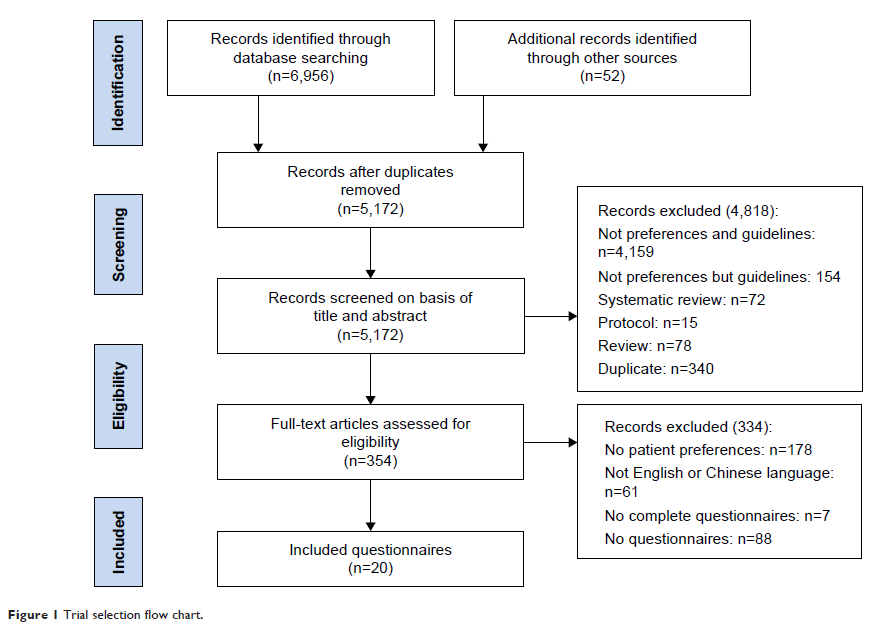
Results: A total of 7,008 records were retrieved by the
search strategy and scanned, and 20 articles were finally included. Of these,
10 (50%) articles described the process of item generation and only four
questionnaires (20%, 4/20) mentioned the pilot testing. Regarding “validity”,
seven questionnaires (35%, 7/20) assessed validity and only one (5%, 1/20)
questionnaire assessed internal consistency, with Cornbrash’s α values of
0.74–0.87. For “acceptability”, the time to complete the questionnaires ranged from
10 to 30 minutes and only nine studies (45%, 9/20) reported the response rates.
In addition, the results of domains and items about patient’s preferences and
values showed that the “effectiveness” domain was the most considered item in
the patient’s value questionnaire followed by “safety”, “prognosis”, and
others, whereas the least considered domain was “physician’s experience”.
Conclusion: Only a few studies have developed questionnaires
with rigorous psychometric methods to measure patient’s preferences and values.
Currently, still there is no valid or reliable questionnaire for patient’s
preferences and values for use when developing clinical practice guidelines.
Further study should be conducted to develop standardized instruments to
measure patient’s preferences and values. This study provides the domains and
items that may be used in formulating questionnaires about patient’s
preferences and values.
Keywords: questionnaires,
guideline, patient’s values and preferences, systematic review, Patient
Satisfaction