119661
论文已发表
注册即可获取德孚的最新动态
IF 收录期刊
- 3.6 Breast Cancer (Dove Med Press)
- 4.3 Clin Epidemiol
- 2.6 Cancer Manag Res
- 3.2 Infect Drug Resist
- 4.1 Clin Interv Aging
- 6.1 Drug Des Dev Ther
- 4.1 Int J Chronic Obstr
- 8.7 Int J Nanomed
- 2.5 Int J Women's Health
- 3.2 Neuropsych Dis Treat
- 2.4 OncoTargets Ther
- 2.6 Patient Prefer Adher
- 2.6 Ther Clin Risk Manag
- 3.1 J Pain Res
- 3.5 Diabet Metab Synd Ob
- 4.5 Psychol Res Behav Ma
- 3.4 Nat Sci Sleep
- 2.4 Pharmgenomics Pers Med
- 2.6 Risk Manag Healthc Policy
- 4.6 J Inflamm Res
- 2.3 Int J Gen Med
- 3.9 J Hepatocell Carcinoma
- 3.3 J Asthma Allergy
- 2.5 Clin Cosmet Investig Dermatol
- 3.0 J Multidiscip Healthc

脂质插入可通过肿瘤穿透双特异性重组蛋白促进负载有紫杉醇的红细胞膜纳米系统的靶向功能化
Authors Chen H, Sha H, Zhang L, Qian H, Chen F, Ding N, Ji L, Zhu A, Xu Q, Meng F, Yu L, Zhou Y, Liu B
Received 13 February 2018
Accepted for publication 25 May 2018
Published 11 September 2018 Volume 2018:13 Pages 5347—5359
DOI https://doi.org/10.2147/IJN.S165109
Checked for plagiarism Yes
Review by Single-blind
Peer reviewers approved by Dr Yu Mi
Peer reviewer comments 7
Editor who approved publication: Dr Linlin Sun
Background: There is currently much interest in cancer cell targeting and tumor penetrating for research and therapeutic purposes.
Purpose: To improve targeting delivery of antitumor drugs to gastric cancer, in this study, a tumor-targeting biocompatible drug delivery system derived from erythrocyte membrane for delivering paclitaxel (PTX) was constructed.
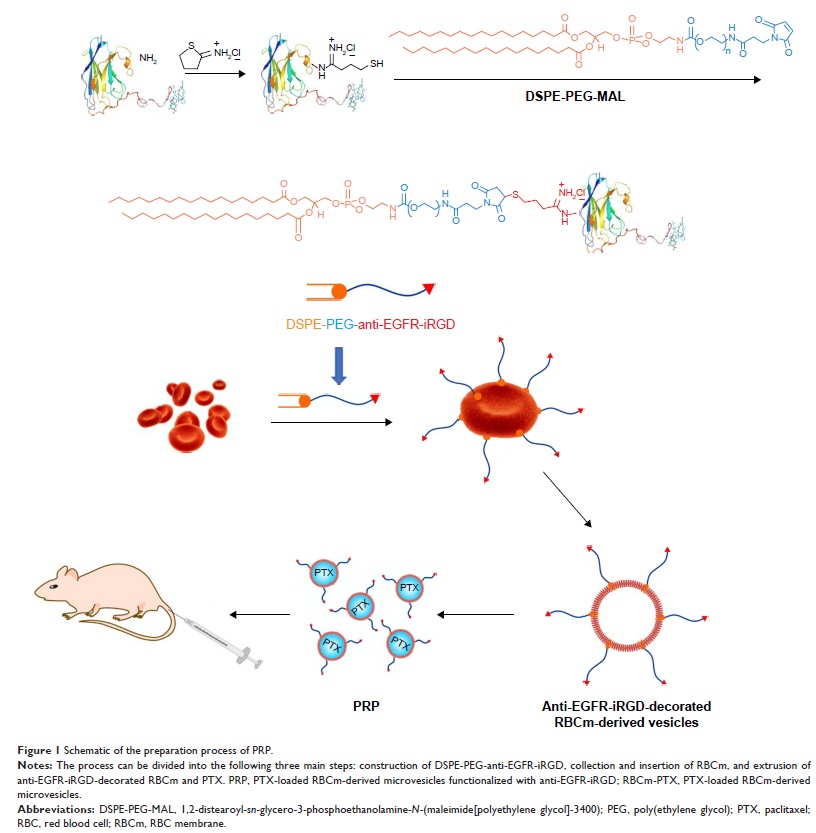
Methods: Erythrocyte membrane of human red blood cells (RBCs) were used for preparing of erythrocyte membrane-derived vesicles. 1,2-distearoyl-sn -glycero-3-phosphoethanolamine-N -(maleimide[polyethylene glycol]-3400) (DSPE-PEG-MAL), a phospholipid derivative, was used to insert tumor-targeting molecular into erythrocyte membrane-derived vesicles. A lipid insertion method was used to functionalize these vesicles without the need for direct chemical conjugation. Furthermore, a tumor-penetrating bispecific recombinant protein named anti-EGFR-iRGD was used for the first time in this work to enable nanosystem to target and penetrate efficiently into the tumor site.
Results: Paclitaxel (PTX)-loaded anti-EGFR-iRGD-modified erythrocyte membrane nanosystem (anti-EGFR-iRGD-RBCm-PTX, abbreviated to PRP) were manufactured. PRP was spheroid, uniformly size, about 171.7±4.7 nm in average, could be stable in vitro for 8 days, and released PTX in a biphasic pattern. PRP showed comparable cytotoxicity toward human gastric cancer cells in vitro. In vivo studies showed that, PRP accumulated in tumor site within 2 h of administration, lasted longer than 48 h, and the tumor volume was reduced 61% by PRP treatment in Balb/c nude mice, without causing severe side effects.
Conclusion: PRP has potential applications in cancer treatment and as an adjunct for other anticancer strategies.
Keywords: tumor-penetrating bispecific recombinant protein, erythrocyte membrane, biomimetic nanoparticle, drug delivery