119661
论文已发表
注册即可获取德孚的最新动态
IF 收录期刊
- 3.6 Breast Cancer (Dove Med Press)
- 4.3 Clin Epidemiol
- 2.6 Cancer Manag Res
- 3.2 Infect Drug Resist
- 4.1 Clin Interv Aging
- 6.1 Drug Des Dev Ther
- 4.1 Int J Chronic Obstr
- 8.7 Int J Nanomed
- 2.5 Int J Women's Health
- 3.2 Neuropsych Dis Treat
- 2.4 OncoTargets Ther
- 2.6 Patient Prefer Adher
- 2.6 Ther Clin Risk Manag
- 3.1 J Pain Res
- 3.5 Diabet Metab Synd Ob
- 4.5 Psychol Res Behav Ma
- 3.4 Nat Sci Sleep
- 2.4 Pharmgenomics Pers Med
- 2.6 Risk Manag Healthc Policy
- 4.6 J Inflamm Res
- 2.3 Int J Gen Med
- 3.9 J Hepatocell Carcinoma
- 3.3 J Asthma Allergy
- 2.5 Clin Cosmet Investig Dermatol
- 3.0 J Multidiscip Healthc

幽门螺杆菌通过 PLK1/PI3K/Akt 通路促进胃上皮细胞存活
Authors Xu W, Huang Y, Yang Z, Hu Y, Shu X, Xie C, He C, Zhu Y, Lu N
Received 6 February 2018
Accepted for publication 22 May 2018
Published 11 September 2018 Volume 2018:11 Pages 5703—5713
DOI https://doi.org/10.2147/OTT.S164749
Checked for plagiarism Yes
Review by Single-blind
Peer reviewers approved by Dr Colin Mak
Peer reviewer comments 4
Editor who approved publication: Dr XuYu Yang
Purpose: Helicobacter pylori (H. pylori ) infection plays a critical role in the process of gastric carcinogenesis. However, the complicated pathogenic mechanism is still unclear. Polo-like kinase 1 (PLK1) is involved in the development of multiple human malignancies, including gastric cancer. Therefore, this study aimed to elucidate the role of PLK1 in H. pylori -induced gastric carcinogenesis and the underlying signaling mechanism.
Materials and methods: We detected the expression of PLK1 in 166 patients in different stages of gastric carcinogenesis as well as the established Mongolian gerbil model with H. pylori infection by immunohistochemistry. Cell Counting Kit-8 was used to estimate the survival of gastric cancer cells.
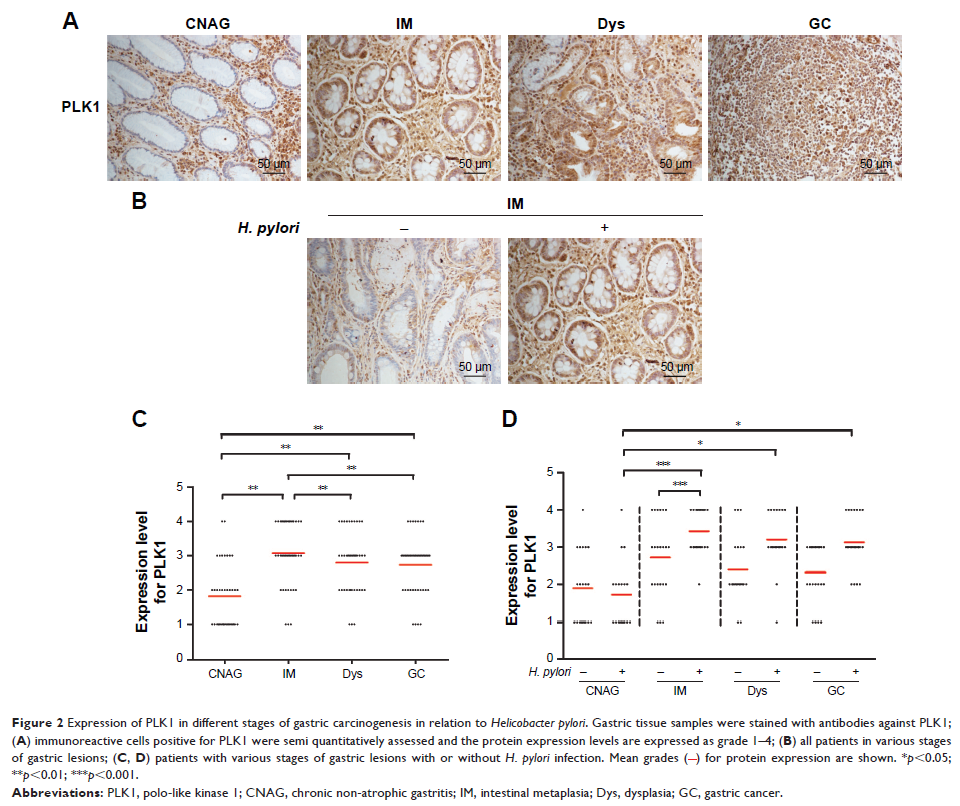
Results: We found that PLK1 expression in gastric cancer tissues was significantly higher than that of paired adjacent mucosa. PLK1 expression was increased in intestinal metaplasia, dysplasia, and gastric cancer tissues compared to chronic non-atrophic gastritis tissues. Notably, PLK1 expression was much lower in H. pylori -negative tissues than in H. pylori -positive tissues at intestinal metaplasia stage. In addition, H. pylori infection increased PLK1 expression in the gastric epithelial cells of the Mongolian gerbil model, which was positively related to the duration of H. pylori infection. Inhibition of PLK1 significantly reduced H. pylori -induced cell proliferation. Furthermore, incubation of MKN-28 cells with H. pylori resulted in a significant increase in PLK1, p-PTEN, and the downstream PI3K/Akt pathway, and pretreatment with a PLK1 inhibitor reversed these molecular changes.
Conclusion: PLK1 is involved in H. pylori -induced gastric carcinogenesis at the early stage by activating the PI3K/Akt signaling pathway. These results may contribute to the development of new control strategies for H. pylori infection-related gastric cancer.
Keywords: gastric carcinogenesis, Helicobacter pylori , PLK1, PI3K/Akt pathway, cell survival