119661
论文已发表
注册即可获取德孚的最新动态
IF 收录期刊
- 3.6 Breast Cancer (Dove Med Press)
- 4.3 Clin Epidemiol
- 2.6 Cancer Manag Res
- 3.2 Infect Drug Resist
- 4.1 Clin Interv Aging
- 6.1 Drug Des Dev Ther
- 4.1 Int J Chronic Obstr
- 8.7 Int J Nanomed
- 2.5 Int J Women's Health
- 3.2 Neuropsych Dis Treat
- 2.4 OncoTargets Ther
- 2.6 Patient Prefer Adher
- 2.6 Ther Clin Risk Manag
- 3.1 J Pain Res
- 3.5 Diabet Metab Synd Ob
- 4.5 Psychol Res Behav Ma
- 3.4 Nat Sci Sleep
- 2.4 Pharmgenomics Pers Med
- 2.6 Risk Manag Healthc Policy
- 4.6 J Inflamm Res
- 2.3 Int J Gen Med
- 3.9 J Hepatocell Carcinoma
- 3.3 J Asthma Allergy
- 2.5 Clin Cosmet Investig Dermatol
- 3.0 J Multidiscip Healthc

挥发性麻醉剂七氟醚抑制肺癌细胞及 miRNA 对肺癌细胞的干扰
Authors Wang L, Wang T, Gu JQ, Su HB
Received 19 April 2018
Accepted for publication 25 June 2018
Published 11 September 2018 Volume 2018:11 Pages 5689—5693
DOI https://doi.org/10.2147/OTT.S171672
Checked for plagiarism Yes
Review by Single-blind
Peer reviewers approved by Dr Cristina Weinberg
Peer reviewer comments 2
Editor who approved publication: Prof. Dr. Geoffrey Pietersz
Purpose: Sevoflurane is widely used in lung cancer surgery. It is well known that volatile anesthetics have a lung-protective effect in lung cancer surgery. However, the association between the inhibition of cancer cells and miRNAs interference remains unknown. Whether sevoflurane can affect some miRNAs in A549 cells has not been reported. The main aim of the present study was to investigate the effect of 3% sevoflurane on A549 cells and assess whether it regulates A549 cells by interfering with miRNA.
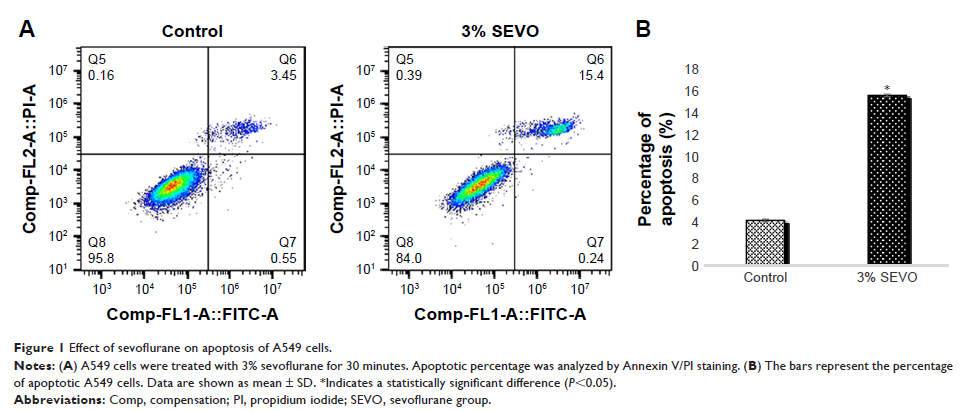
Methods: In three percent sevoflurane-pretreated A549 cells, treated for a duration of 30 minutes, the apoptosis rate of A549 cells was evaluated using a flow cytometer. The expression of 6 types of miRNAs associated with non-small cell lung cancer was analyzed by real-time quantitative polymerase chain reaction.
Results: An obvious apoptosis-promoting effect was found in A549 cells, which had been treated with 3% sevoflurane. The expression of several miRNAs that regulate apoptosis was significantly changed compared with the control group.
Conclusion: Three percent sevoflurane can significantly increase the apoptosis rate of A549 cells, which may reduce the spread of cancer cells caused by operation. Sevoflurane disturbed the expression of the miRNAs that regulate apoptosis.
Keywords: sevoflurane, miRNAs, apoptosis