119370
论文已发表
注册即可获取德孚的最新动态
IF 收录期刊
- 3.6 Breast Cancer (Dove Med Press)
- 4.3 Clin Epidemiol
- 2.6 Cancer Manag Res
- 3.2 Infect Drug Resist
- 4.1 Clin Interv Aging
- 6.1 Drug Des Dev Ther
- 4.1 Int J Chronic Obstr
- 8.7 Int J Nanomed
- 2.5 Int J Women's Health
- 3.2 Neuropsych Dis Treat
- 2.4 OncoTargets Ther
- 2.6 Patient Prefer Adher
- 2.6 Ther Clin Risk Manag
- 3.1 J Pain Res
- 3.5 Diabet Metab Synd Ob
- 4.5 Psychol Res Behav Ma
- 3.4 Nat Sci Sleep
- 2.4 Pharmgenomics Pers Med
- 2.6 Risk Manag Healthc Policy
- 4.6 J Inflamm Res
- 2.3 Int J Gen Med
- 3.9 J Hepatocell Carcinoma
- 3.3 J Asthma Allergy
- 2.5 Clin Cosmet Investig Dermatol
- 3.0 J Multidiscip Healthc

城市变应性鼻炎儿童变应性致敏原致敏谱 10 年回顾性研究
Authors Yang LF, Cai LM, Li M, Liu JT, Wang ZN, Wang WH, Yang QT, Chen ZG
Received 20 October 2017
Accepted for publication 15 January 2018
Published 26 February 2018 Volume 2018:14 Pages 409—416
DOI https://doi.org/10.2147/TCRM.S154692
Checked for plagiarism Yes
Review by Single-blind
Peer reviewers approved by Dr Hoa Le
Peer reviewer comments 2
Editor who approved publication: Professor Deyun Wang
Objective: To investigate the alterative spectrum and trends of aeroallergens
sensitization in children with allergic rhinitis (AR) in Guangzhou, China in
the past 10 years.
Participants and
methods: In this
retrospective study, 4,111 children with complaints of nasal hyper-reactivity
who visited the Pediatric Department and/or Otolaryngology Department from
January 2007 to November 2016 were enrolled. Serum specific immunoglobulin E
was measured and positive detection was made in 3,328 patients, who were,
therefore, diagnosed with AR. Positive rates and trends of different
aeroallergens sensitization were assessed. The tendency of positive rates
changing over the years, and the difference and trends in positive rate of
aeroallergen sensitization that occurred in subgroups of gender, age, and
season were determined and analyzed with logistic regression.
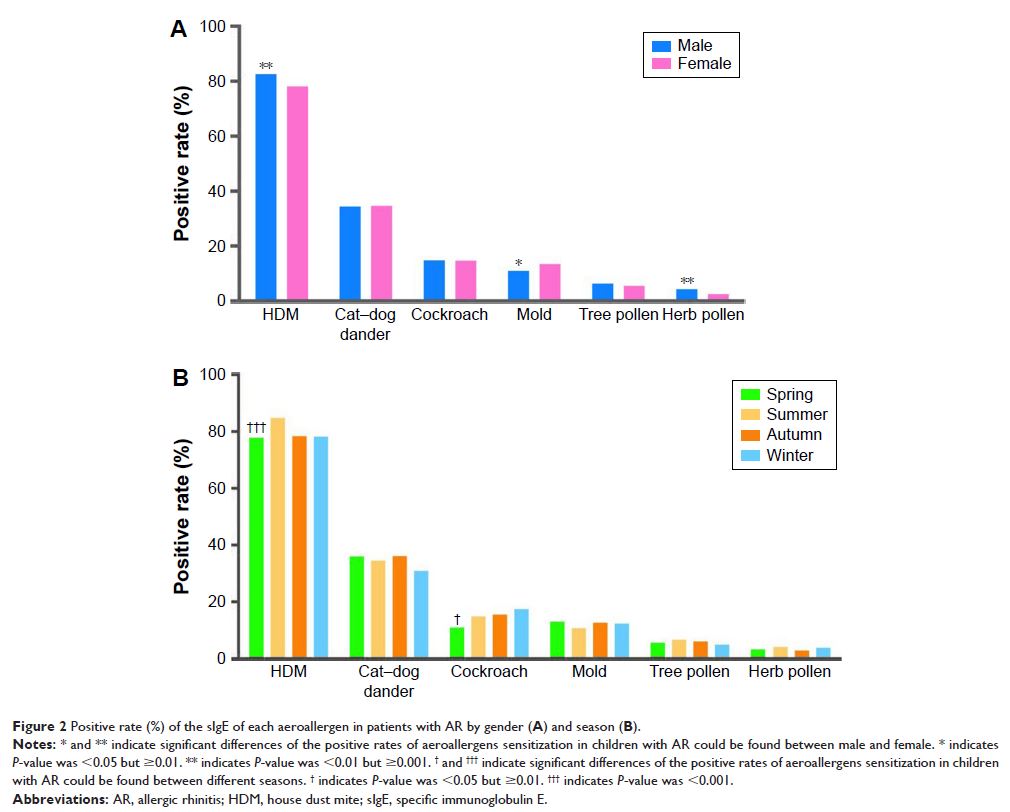
Results: The percentage of detected common aeroallergens in AR
children was (from high to low) 81.07%, 34.44%, 14.72%, 11.81%, 6.04%, and
3.70% for house dust mites (HDMs), cat–dog dander, cockroach, mold mixture,
tree pollen mixture, and herb pollen mixture, respectively. An ascending trend
of aeroallergens sensitization or AR (odds ratio [OR] =1.116, 95% CI:
1.086–1.146) was found. Interestingly, an increasing trend of cat–dog dander
and mold sensitization was found in AR children (OR =1.164, 95% CI:
1.133–1.196; OR =1.169, 95% CI: 1.120–1.223) in this retrospective study, while
HDMs sensitization held a steady trend (OR =0.983, 95% CI: 0.961–1.007).
Conclusion: In the increasing trend of aeroallergens
sensitization or AR, HDMs sensitization still held the majority. But emphasis
should be made on pet allergy for young children with AR in the context of
ascending trend of sensitization to cat–dog dander.
Keywords: allergic
rhinitis, aeroallergen, children, sIgE