118847
论文已发表
注册即可获取德孚的最新动态
IF 收录期刊
- 3.6 Breast Cancer (Dove Med Press)
- 4.3 Clin Epidemiol
- 2.6 Cancer Manag Res
- 3.2 Infect Drug Resist
- 4.1 Clin Interv Aging
- 6.1 Drug Des Dev Ther
- 4.1 Int J Chronic Obstr
- 8.7 Int J Nanomed
- 2.5 Int J Women's Health
- 3.2 Neuropsych Dis Treat
- 2.4 OncoTargets Ther
- 2.6 Patient Prefer Adher
- 2.6 Ther Clin Risk Manag
- 3.1 J Pain Res
- 3.5 Diabet Metab Synd Ob
- 4.5 Psychol Res Behav Ma
- 3.4 Nat Sci Sleep
- 2.4 Pharmgenomics Pers Med
- 2.6 Risk Manag Healthc Policy
- 4.6 J Inflamm Res
- 2.3 Int J Gen Med
- 3.9 J Hepatocell Carcinoma
- 3.3 J Asthma Allergy
- 2.5 Clin Cosmet Investig Dermatol
- 3.0 J Multidiscip Healthc

细胞外囊泡–癌症治疗中的先进纳米载体:进展和成就
Authors Huyan T, Li H, Peng H, Chen J, Yang R, Zhang W, Li Q
Received 11 November 2019
Accepted for publication 8 July 2020
Published 26 August 2020 Volume 2020:15 Pages 6485—6502
DOI https://doi.org/10.2147/IJN.S238099
Checked for plagiarism Yes
Review by Single anonymous peer review
Peer reviewer comments 4
Editor who approved publication: Prof. Dr. Thomas Webster
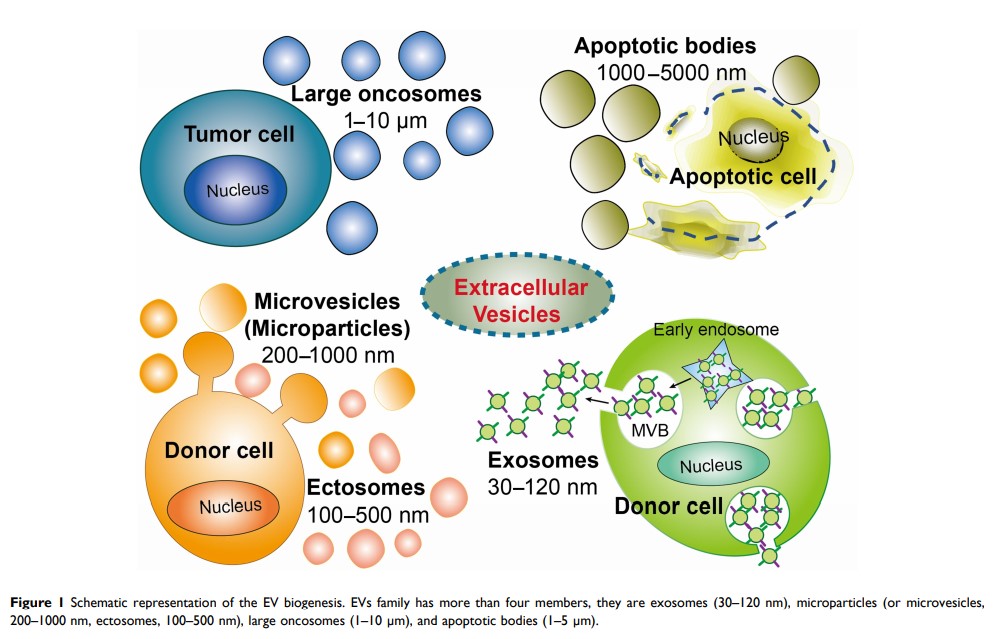
Abstract: Extracellular vesicles (EVs) are a class of cell-derived, lipid bilayer membrane composed vesicles, and some of them such as exosomes and ectosomes have been proven, playing remarkable roles in transmitting intercellular information, and being involved in each property of cell physiological activities. Nowadays, EVs are considered as potential nanocarriers which could partially resolve the problems of current chemotherapy because of their distinctive advantages. As endogenous membrane encompassed vesicles with nanosize, EVs are able to pass through the natural barriers with prolonged circulation time in vivo and have intrinsic cell targeting properties, they are less toxic, and less immunogenic. Recently, studies focusing on EV-based drug delivery system for cancer therapy have exploded dramatically. This review aims to outline the current applications of EVs as potential nanosized drug carriers in cancer therapy. Firstly, the characteristics and biofunctions of each EV subtype are described. Then the variety of therapeutic cargoes, the loading methods, and the targeting strategy of engineered EVs are emphatically introduced. Thereafter the pros and cons of EVs applied as therapeutic carriers, as well as the future prospects in this field, are discussed.
Keywords: Extracellular vesicles, exosomes, nano-sized carriers, tumor, drug delivery system