118847
论文已发表
注册即可获取德孚的最新动态
IF 收录期刊
- 3.6 Breast Cancer (Dove Med Press)
- 4.3 Clin Epidemiol
- 2.6 Cancer Manag Res
- 3.2 Infect Drug Resist
- 4.1 Clin Interv Aging
- 6.1 Drug Des Dev Ther
- 4.1 Int J Chronic Obstr
- 8.7 Int J Nanomed
- 2.5 Int J Women's Health
- 3.2 Neuropsych Dis Treat
- 2.4 OncoTargets Ther
- 2.6 Patient Prefer Adher
- 2.6 Ther Clin Risk Manag
- 3.1 J Pain Res
- 3.5 Diabet Metab Synd Ob
- 4.5 Psychol Res Behav Ma
- 3.4 Nat Sci Sleep
- 2.4 Pharmgenomics Pers Med
- 2.6 Risk Manag Healthc Policy
- 4.6 J Inflamm Res
- 2.3 Int J Gen Med
- 3.9 J Hepatocell Carcinoma
- 3.3 J Asthma Allergy
- 2.5 Clin Cosmet Investig Dermatol
- 3.0 J Multidiscip Healthc

低氧诱导的水通道蛋白-3 通过激活 PI3K/Akt 信号通路改变肝细胞癌细胞对索拉非尼的敏感性
Authors Malale K, Fu J, Qiu L, Zhan K, Gan X, Mei Z
Received 30 December 2019
Accepted for publication 12 May 2020
Published 9 June 2020 Volume 2020:12 Pages 4321—4333
DOI https://doi.org/10.2147/CMAR.S243918
Checked for plagiarism Yes
Review by Single-blind
Peer reviewer comments 2
Editor who approved publication: Dr Beicheng Sun
Purpose: Hypoxia-induced changes are primarily activated in patients with hepatocellular carcinoma (HCC) and long-term sorafenib exposure, thereby reducing the sensitivity to the drug. Aquaporin-3 (AQP3), a member of the aquaporin family, is a hypoxia-induced substance that affects the chemosensitivity of non-hepatocellular tumors. However, its expression and role in the sensitivity of hypoxic HCC cells to sorafenib-induced apoptosis remain unclear. The purpose of this study was to detect changes in AQP3 expression in hypoxic HCC cells and to determine whether these changes alter the sensitivity of these cells to sorafenib.
Materials and Methods: Huh7 and HepG2 hypoxic cell models were established and AQP3 expression was detected using quantitative real-time polymerase chain reaction (qPCR) and Western blotting. Furthermore, the role of AQP3 in cell sensitivity to sorafenib was evaluated via flow cytometry, Western blotting, and a CCK-8 assay.
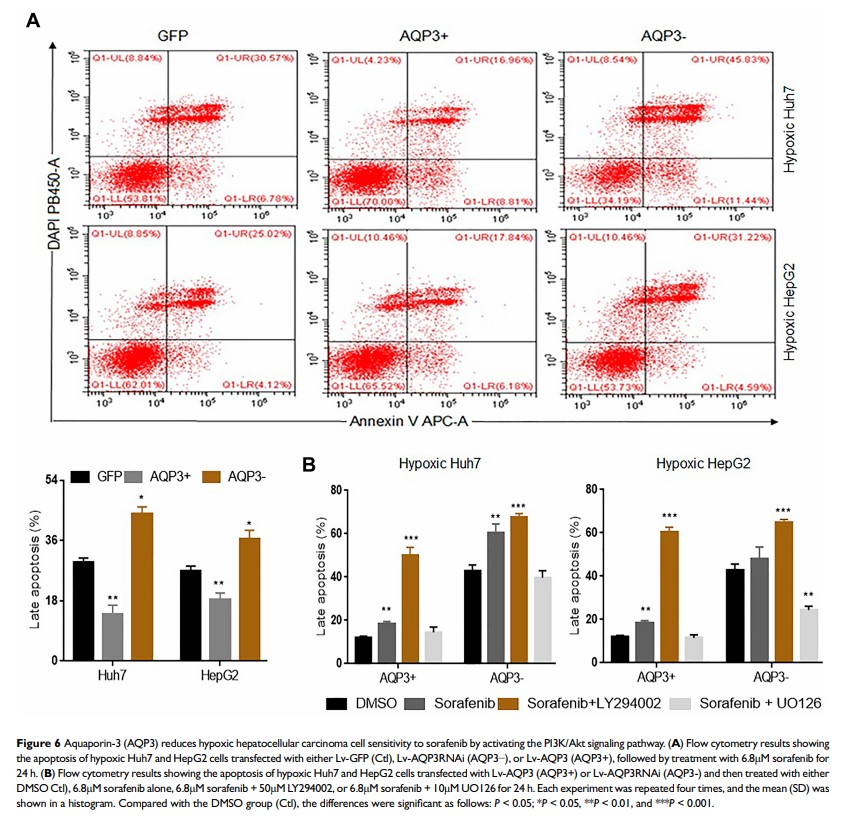
Results: The results of qPCR and Western blotting showed that AQP3 was overexpressed in the Huh7 and HepG2 hypoxic cell models. Furthermore, AQP3 protein levels were positively correlated with hypoxia-inducible factor-1α (HIF-1α) levels. Compared with cells transfected with lentivirus-GFP (Lv-GFP), hypoxic cells transfected with lentivirus-AQP3 (Lv-AQP3) were less sensitive to sorafenib-induced apoptosis. However, the sensitivity to the drug increased in cells transfected with lentivirus-AQP3RNAi (Lv-AQP3RNAi). Akt and Erk phosphorylation was enhanced in Lv-AQP3-transfected cells. Compared with UO126 (a Mek1/2 inhibitor), LY294002 (a PI3K inhibitor) attenuated the AQP3-induced insensitivity to sorafenib observed in hypoxic cells transfected with Lv-AQP3. Combined with LY294002-treated cells, hypoxic cells transfected with Lv-AQP3RNAi were more sensitive to sorafenib.
Conclusion: The study results show that AQP3 is a potential therapeutic target for improving the sensitivity of hypoxic HCC cells to sorafenib.
Keywords: AQP3, hypoxia, hypoxic HCC cells, hypoxia-inducible factor 1α, PI3K/Akt and Erk signaling pathways, sorafenib resistance