118847
论文已发表
注册即可获取德孚的最新动态
IF 收录期刊
- 3.6 Breast Cancer (Dove Med Press)
- 4.3 Clin Epidemiol
- 2.6 Cancer Manag Res
- 3.2 Infect Drug Resist
- 4.1 Clin Interv Aging
- 6.1 Drug Des Dev Ther
- 4.1 Int J Chronic Obstr
- 8.7 Int J Nanomed
- 2.5 Int J Women's Health
- 3.2 Neuropsych Dis Treat
- 2.4 OncoTargets Ther
- 2.6 Patient Prefer Adher
- 2.6 Ther Clin Risk Manag
- 3.1 J Pain Res
- 3.5 Diabet Metab Synd Ob
- 4.5 Psychol Res Behav Ma
- 3.4 Nat Sci Sleep
- 2.4 Pharmgenomics Pers Med
- 2.6 Risk Manag Healthc Policy
- 4.6 J Inflamm Res
- 2.3 Int J Gen Med
- 3.9 J Hepatocell Carcinoma
- 3.3 J Asthma Allergy
- 2.5 Clin Cosmet Investig Dermatol
- 3.0 J Multidiscip Healthc

1990 年至 2017 年中国结核病的流行趋势:全球疾病负担研究的证据
Authors Ding C, Wang S, Shangguan Y, Feng X, Guo W, Shi P, Ji Z, Xu K
Received 13 February 2020
Accepted for publication 15 May 2020
Published 9 June 2020 Volume 2020:13 Pages 1663—1672
DOI https://doi.org/10.2147/IDR.S249698
Checked for plagiarism Yes
Review by Single-blind
Peer reviewer comments 2
Editor who approved publication: Dr Joachim Wink
Purpose: Tuberculosis remains a major public health problem globally, especially in undeveloped countries. This study aimed to evaluate and review the long-term epidemic trends of tuberculosis in China.
Methods: Data were extracted from the Global Health Data Exchange. Metrics (prevalence, incidence and mortality) and Joinpoint regression were used to identify the epidemic trends.
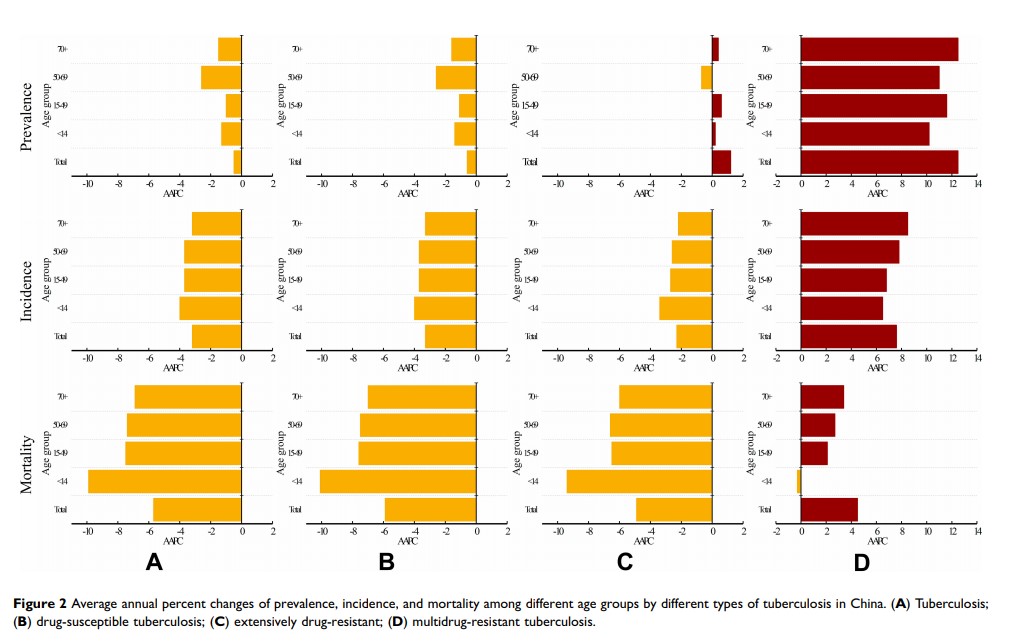
Results: From 1990 to 2017, decreasing trends in prevalence (average annual percent change, AAPC: − 0.5%, 95% CI: − 0.6% to − 0.5%), incidence (− 3.2%, 95% CI: − 3.5% to − 2.9%), and mortality (− 5.7%, 95% CI: − 6.2% to − 5.3%) of tuberculosis were observed. The incidence and mortality of multidrug-resistant tuberculosis (MDR-TB) decreased with AAPC of − 2.3% (− 3.1% to − 1.4%) and − 4.9% (− 5.4% to − 4.5%), respectively, while the prevalence increased with an AAPC of 1.2% (0.3% to 2.0%). The burden of extensively drug-resistant tuberculosis (XDR-TB) increased with an AAPC of 12.5% (11.9% to 13.2%) in prevalence, 7.6% (6.5% to 8.7%) in incidence, and 4.5% (3.6% to 5.4%) in mortality. The disease burden of tuberculosis increased with age and peaked among those aged over 70.
Conclusion: The epidemic of tuberculosis decreased in China, while the disease burden was still challenging to control. MDR-TB and XDR-TB should be emphasized along with the epidemic. It will certainly be a difficult task to achieve the post-2015 global targets by 2025 and 2035.
Keywords: tuberculosis, drug-resistant, epidemic, China