118847
论文已发表
注册即可获取德孚的最新动态
IF 收录期刊
- 3.6 Breast Cancer (Dove Med Press)
- 4.3 Clin Epidemiol
- 2.6 Cancer Manag Res
- 3.2 Infect Drug Resist
- 4.1 Clin Interv Aging
- 6.1 Drug Des Dev Ther
- 4.1 Int J Chronic Obstr
- 8.7 Int J Nanomed
- 2.5 Int J Women's Health
- 3.2 Neuropsych Dis Treat
- 2.4 OncoTargets Ther
- 2.6 Patient Prefer Adher
- 2.6 Ther Clin Risk Manag
- 3.1 J Pain Res
- 3.5 Diabet Metab Synd Ob
- 4.5 Psychol Res Behav Ma
- 3.4 Nat Sci Sleep
- 2.4 Pharmgenomics Pers Med
- 2.6 Risk Manag Healthc Policy
- 4.6 J Inflamm Res
- 2.3 Int J Gen Med
- 3.9 J Hepatocell Carcinoma
- 3.3 J Asthma Allergy
- 2.5 Clin Cosmet Investig Dermatol
- 3.0 J Multidiscip Healthc

小檗碱通过遏制 iPLA2/LOX-5/LTB4 信号通路来抑制肝细胞癌中细胞凋亡诱导的转移
Authors Zhao Y, He K, Zheng H, Sun M, Shi T, Zheng X, Shao D, Zhang H, Guan F, Li J, Chen L
Received 22 December 2019
Accepted for publication 12 May 2020
Published 9 June 2020 Volume 2020:13 Pages 5223—5230
DOI https://doi.org/10.2147/OTT.S243357
Checked for plagiarism Yes
Review by Single-blind
Peer reviewer comments 2
Editor who approved publication: Dr Leo Jen-Liang Su
Purpose: Hepatocellular carcinoma (HCC) is one of the most malignant cancers around the world. HCC is less sensitive to conventional cytotoxic agents and easily develops into systemic metastases. However, the molecular mechanisms of the metastasis of HCC are poorly understood and need elucidation.
Materials and Methods: Transwell system of the chemotherapy-challenged and unchallenged HepG2 cells was established. Adhesion assay and scratch-wound assay were utilized to analyze the adhesion and migration of HepG2 cells. iPLA2 and LOX-5 expression were analyzed by Western blot. LTB4 level was analyzed by ELISA.
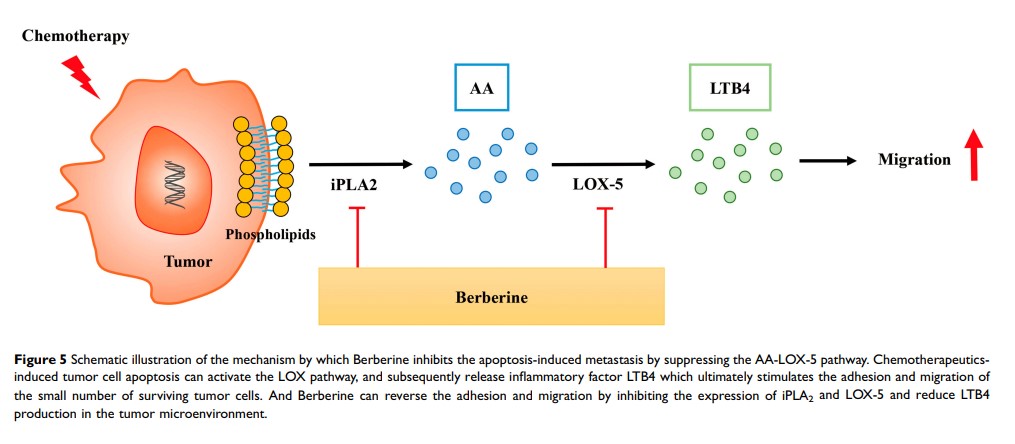
Results: Chemotherapeutics are traditionally regarded as a way of killing tumor cells; on the other hand, we proved that the chemotherapeutics-induced tumor cell apoptosis can also change the tumor microenvironment by activating the LOX pathway and subsequently release inflammatory factors such as LTB4 which can stimulate the adhesion and migration of the small number of surviving cells. Berberine can reverse the adhesion and migration of HepG2 cells by inhibiting the expression of LOX-5 and reducing the LTB4 production in the tumor microenvironment.
Conclusion: Our study sheds light on a novel anti-metastasis strategy that the combination of Berberine and chemotherapy may prevent the chemotherapy-induced metastasis in HCC.
Keywords: hepatocellular carcinoma, Berberine, chemotherapy, metastasis, LOX-5