118847
论文已发表
注册即可获取德孚的最新动态
IF 收录期刊
- 3.6 Breast Cancer (Dove Med Press)
- 4.3 Clin Epidemiol
- 2.6 Cancer Manag Res
- 3.2 Infect Drug Resist
- 4.1 Clin Interv Aging
- 6.1 Drug Des Dev Ther
- 4.1 Int J Chronic Obstr
- 8.7 Int J Nanomed
- 2.5 Int J Women's Health
- 3.2 Neuropsych Dis Treat
- 2.4 OncoTargets Ther
- 2.6 Patient Prefer Adher
- 2.6 Ther Clin Risk Manag
- 3.1 J Pain Res
- 3.5 Diabet Metab Synd Ob
- 4.5 Psychol Res Behav Ma
- 3.4 Nat Sci Sleep
- 2.4 Pharmgenomics Pers Med
- 2.6 Risk Manag Healthc Policy
- 4.6 J Inflamm Res
- 2.3 Int J Gen Med
- 3.9 J Hepatocell Carcinoma
- 3.3 J Asthma Allergy
- 2.5 Clin Cosmet Investig Dermatol
- 3.0 J Multidiscip Healthc

多发性硬化症中嗅觉刺激引起的功能性脑激活模式的变化
Authors OuYang Q, Wang Y, Zhang Y, Yu M, Wang X
Received 8 March 2020
Accepted for publication 1 May 2020
Published 9 June 2020 Volume 2020:16 Pages 1451—1458
DOI https://doi.org/10.2147/NDT.S252933
Checked for plagiarism Yes
Review by Single-blind
Peer reviewer comments 2
Editor who approved publication: Professor Jun Chen
Background: Olfactory disorder is one of the commonly appearing symptoms in diseases like Parkinson’s disease (PD) and Alzheimer’s disease (AD). However, reports of olfactory changes in multiple sclerosis (MS) are scarce and usually ignored or seldom recognized by clinicians. The majority of current research is based on subjective answers obtained by smelling odorants.
Objective: To gain better insights into the central brain regions involved in the olfactory process. We measured preliminary contrast assessment characteristics of brain activation in MS patients and healthy controls using functional magnetic resonance imaging (fMRI) under an odor stimulation task.
Methods: Olfactory event-related fMRI was used to assess the olfactory network neuronal activity during passively inhaled volatile gases of lavender and rose solutions alternately in 18 MS patients and 20 healthy sex- and age-matched adults. Spearman correlation analysis was conducted between the lesions in central and olfactory-induced activated brain regions.
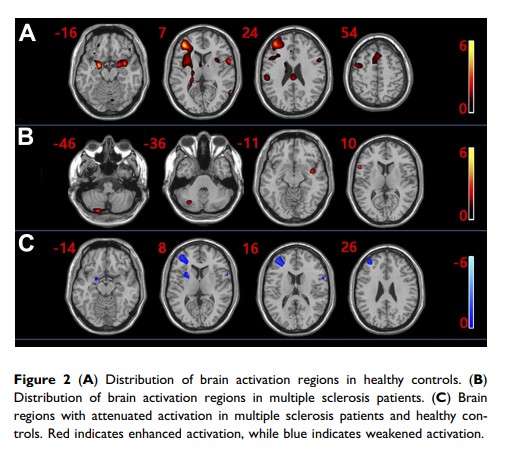
Results: We observed significant reductions in the number of activated brain areas compared with healthy controls in MS patients under a standard activation mode; the right insula, right amygdala, right inferior frontal gyrus, right frontal middle gyrus, and left supramarginal gyrus were activated in MS patients (t = 2.04, P < 0.05). Meanwhile, the intensity of the activated olfactory brain network revealed attenuation. The Spearman correlation analysis indicated the distribution and number of demyelination lesions, exerting a little impact on major activation of brain regions during olfactory stimulation (r = – 0.524, P = 0.054).
Conclusion: This study establishes that olfaction-related brain regions were altered in patients with MS confirmed by fMRI. The finding refreshes the awareness that olfactory disturbance involved just in structural pathology like olfactory bulbs and tracts or olfactory sulcus, which reportedly is responsible for the deficits.
Keywords: multiple sclerosis, olfactory, magnetic resonance imaging, brain