118847
论文已发表
注册即可获取德孚的最新动态
IF 收录期刊
- 3.6 Breast Cancer (Dove Med Press)
- 4.3 Clin Epidemiol
- 2.6 Cancer Manag Res
- 3.2 Infect Drug Resist
- 4.1 Clin Interv Aging
- 6.1 Drug Des Dev Ther
- 4.1 Int J Chronic Obstr
- 8.7 Int J Nanomed
- 2.5 Int J Women's Health
- 3.2 Neuropsych Dis Treat
- 2.4 OncoTargets Ther
- 2.6 Patient Prefer Adher
- 2.6 Ther Clin Risk Manag
- 3.1 J Pain Res
- 3.5 Diabet Metab Synd Ob
- 4.5 Psychol Res Behav Ma
- 3.4 Nat Sci Sleep
- 2.4 Pharmgenomics Pers Med
- 2.6 Risk Manag Healthc Policy
- 4.6 J Inflamm Res
- 2.3 Int J Gen Med
- 3.9 J Hepatocell Carcinoma
- 3.3 J Asthma Allergy
- 2.5 Clin Cosmet Investig Dermatol
- 3.0 J Multidiscip Healthc

术前血清 CEA 和 CA125 水平作为独立的预后生物标志物对早期宫颈腺癌患者的联合评估
Authors Huang G, Chen R, Lu N, Chen Q, Lv W, Li B
Received 20 February 2020
Accepted for publication 13 May 2020
Published 8 June 2020 Volume 2020:13 Pages 5155—5164
DOI https://doi.org/10.2147/OTT.S250614
Checked for plagiarism Yes
Review by Single-blind
Peer reviewer comments 2
Editor who approved publication: Prof. Dr. Nicola Silvestris
Purpose: There is currently a lack of research on preoperative prognostic analysis of early-stage cervical adenocarcinoma (ADC). The purpose of our study was to clarify whether preoperative serum tumor-marker levels were of prognostic value in early-stage ADC.
Patients and Methods: We performed a retrospective study of patients with International Federation of Gynecology and Obstetrics (FIGO) stage IA1–IIA1 and pathology-proven invasive ADC. We evaluated the relationship between preoperative serum tumor-marker levels and clinicopathological characteristics, and identified the relative preoperative risk factors affecting disease-free survival (DFS) and overall survival (OS). The optimal cut-off point of meaningful tumor markers was determined by the analysis of receiver operating characteristics (ROC), and the accuracy of the results was evaluated by the area under the curve (AUC).
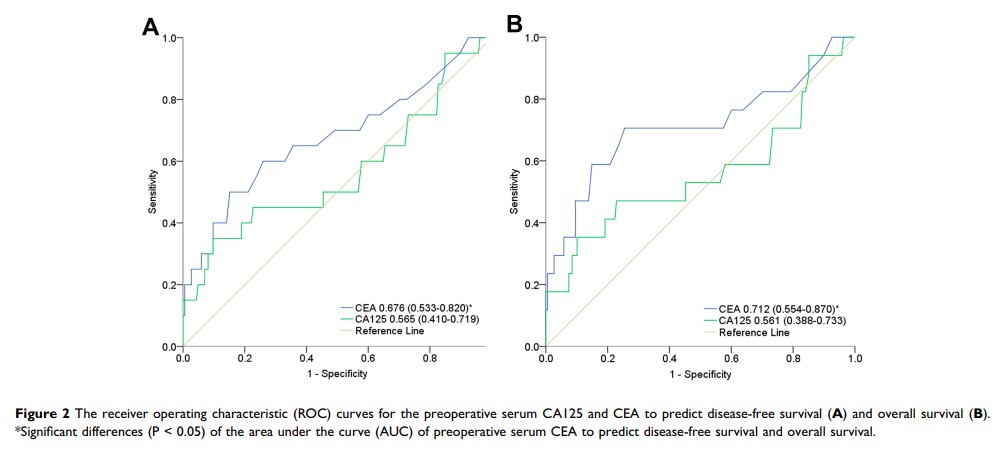
Results: Elevated carcinoembryonic antigen (CEA), carbohydrate antigen 125 (CA125), squamous cell carcinoma antigen (SCC-Ag), alpha-fetoprotein (AFP), carbohydrate antigen 153 (CA153) and carbohydrate antigen 199 (CA199) were associated with certain clinicopathologic features of early-stage ADC. The combination of elevated serum CEA and CA125 was significantly associated with FIGO stage, body mass index (BMI) and LNM. Kaplan–Meier survival curve and Cox regression analyses revealed that CEA and CA125 might have significant prognostic implications in early-stage ADC patients, and the combination of elevated serum CEA and CA125 served as an independent predictor of early-stage ADC. The optimal cut-off point of serum CA125 for prediction DFS and OS was 32.60 U/mL and of serum CEA were 2.85 ng/mL and 2.05 ng/mL, respectively. The AUC showed that serum CEA was a moderate predictor of OS.
Conclusion: The preoperative serum levels of CEA and CA125 might have significant prognostic implications in early-stage ADC patients. Combined preoperative serum CEA and CA125 levels independently predicted the prognosis of early-stage ADC.
Keywords: the early-stage cervical adenocarcinoma, carcinoembryonic antigen, cancer antigen 125, prognosis