118847
论文已发表
注册即可获取德孚的最新动态
IF 收录期刊
- 3.6 Breast Cancer (Dove Med Press)
- 4.3 Clin Epidemiol
- 2.6 Cancer Manag Res
- 3.2 Infect Drug Resist
- 4.1 Clin Interv Aging
- 6.1 Drug Des Dev Ther
- 4.1 Int J Chronic Obstr
- 8.7 Int J Nanomed
- 2.5 Int J Women's Health
- 3.2 Neuropsych Dis Treat
- 2.4 OncoTargets Ther
- 2.6 Patient Prefer Adher
- 2.6 Ther Clin Risk Manag
- 3.1 J Pain Res
- 3.5 Diabet Metab Synd Ob
- 4.5 Psychol Res Behav Ma
- 3.4 Nat Sci Sleep
- 2.4 Pharmgenomics Pers Med
- 2.6 Risk Manag Healthc Policy
- 4.6 J Inflamm Res
- 2.3 Int J Gen Med
- 3.9 J Hepatocell Carcinoma
- 3.3 J Asthma Allergy
- 2.5 Clin Cosmet Investig Dermatol
- 3.0 J Multidiscip Healthc

miR-370-3p 通过抑制炎症反应和上皮-间质转化,减轻小鼠溃疡性结肠炎相关的结直肠癌
Authors Lin L, Wang D, Qu S, Zhao H, Lin Y
Received 11 November 2019
Accepted for publication 27 February 2020
Published 13 March 2020 Volume 2020:14 Pages 1127—1141
DOI https://doi.org/10.2147/DDDT.S238124
Checked for plagiarism Yes
Review by Single-blind
Peer reviewer comments 2
Editor who approved publication: Dr Anastasios Lymperopoulos
Introduction: Ulcerative colitis (UC) is a chronic and inflammatory bowel disease. UC-associated colorectal cancer (UC-CRC) is one of the most severe complications of long-standing UC. In the present study, we explored the effects of miR-370-3p on UC-CRC in vivo and investigated its underlying mechanisms in vivo and in vitro.
Methods: Azoxymethane (AOM) and dextran sodium sulfate (DSS) were used to induce UC-CRC in C57BL/6 mice. AOM/DSS-induced mice were treated with 5× 10⁸ pfu miR-370-3p overexpressing-adenovirus via tail-vein injection every two weeks.
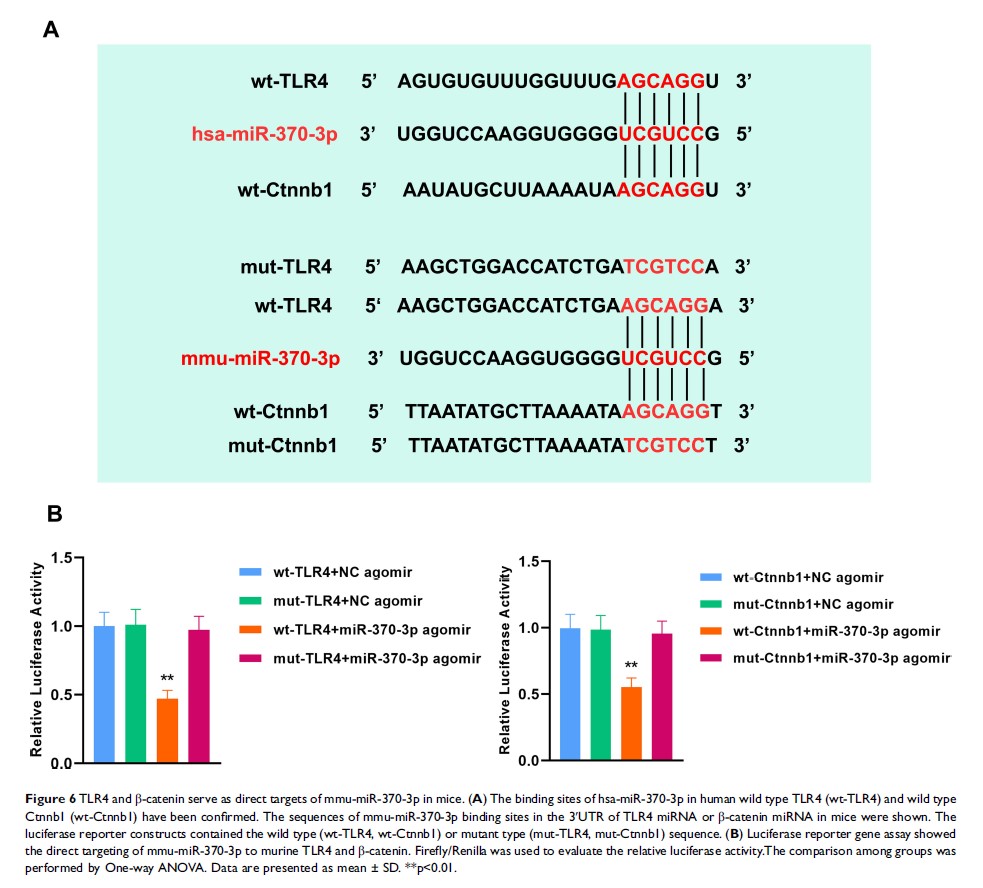
Results: We found that miR-370-3p significantly improved the body weights and survival rates and inhibited the tumorigenesis of UC-CRC in AOM/DSS mice. Mechanically, miR-370-3p inhibited AOM/DSS-induced inflammatory response by decreasing tumor necrosis factor-α (TNF-α), interleukin-1β (IL-1β), and interleukin-6 (IL-6) through targeting toll-like receptor 4 (TLR4), as demonstrated by down-regulation of TLR4, cyclooxygenase-2 (COX-2), prostaglandin E2 (PGE2), and phosphorylated epidermal growth factor receptor (pEGFR). miR-370-3p decreased the expression of tumor-associated proteins, including p53, β-catenin, and ki67 in AOM/DSS-treated mice. Additionally, miR-370-3p remarkably inhibited epithelial-mesenchymal transition (EMT) via increasing E-cadherin expression and reducing N-cadherin and Vimentin expression in vivo. Further studies showed that miR-370-3p repressed proliferation and EMT of colon cancer cells in vitro. Moreover, we proved that miR-370-3p decreased the expression of tumor-associated proteins and reversed EMT by regulating β-catenin in colon cancer cells.
Conclusion: Taken together, miR-370-3p alleviated UC-CRC by inhibiting the inflammatory response and EMT in mice, which suggested miR-370-3p as a novel potential target for UC-CRC therapy.
Keywords: ulcerative colitis-associated colorectal cancer, azoxymethane/dextran sodium sulfate, inflammatory response, epithelia-mesenchymal transition, carcinogenesis